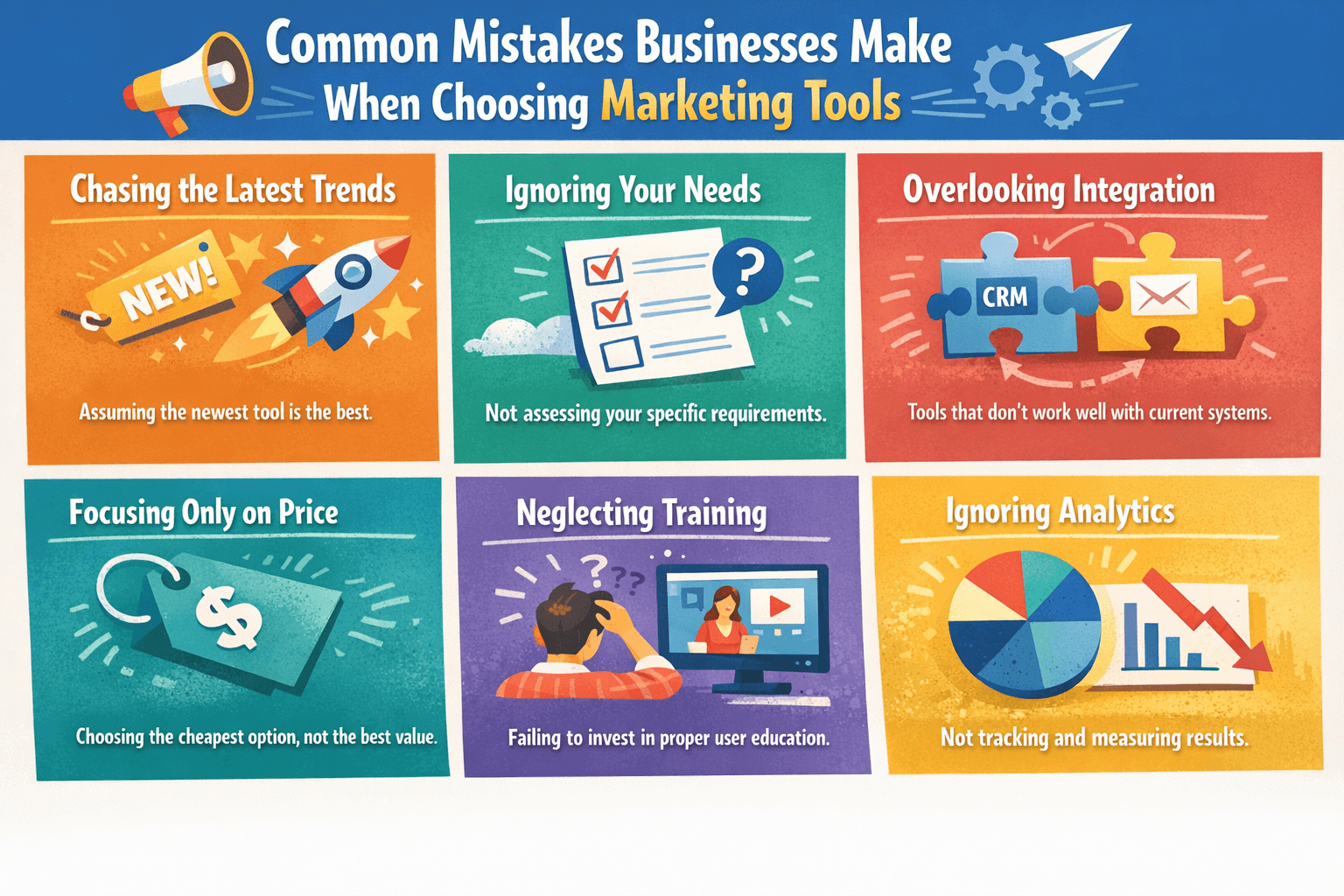
Common Mistakes Businesses Make When Choosing Marketing Tools
I’ve watched “choosing a marketing tool” turn into a weird mix of optimism and self-sabotage. The optimism is real: a new platform feels like a fresh start, like the messy parts of marketing—forgotten follow-ups, inconsistent posting, random spreadsheets—are about to become organized with one subscription.
The self-sabotage usually arrives later, quietly, in the form of a tool nobody wants to open.
Most businesses don’t choose the wrong tool because they’re careless. They choose the wrong tool because they’re busy, they’re making decisions under pressure, and marketing tools are really good at showing you the best possible version of your future self.
Here are the mistakes I see constantly—the ones that cost the most time, the most money, and the most momentum.
Buying a tool for the business you hope to become next year
This is the most common trap. A platform looks impressive, so you assume you’ll grow into it. The feature set is massive, so it must be “future-proof.”
Then reality shows up. You’re still running the business, still answering customers, still putting out small fires, and the tool expects you to build a complex system before it becomes useful.
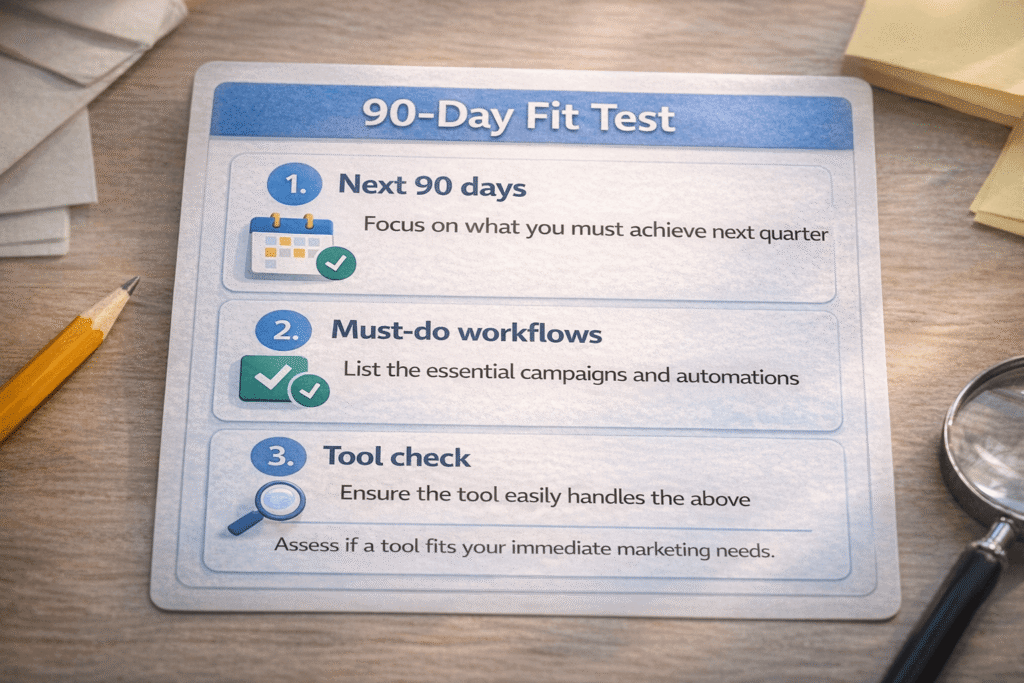
I’ve learned to pick tools based on what I’ll actually do in the next few months, not what I think I should do someday. The businesses that stick with a tool aren’t the ones with the biggest ambitions—they’re the ones whose tools match their current rhythm.
Confusing “more features” with “more results”
Tool marketing loves the fantasy of “all-in-one.” Email, SMS, landing pages, ads, CRM, scheduling, analytics, AI copy—everything in one dashboard.
But results rarely come from the dashboard. They come from the habit: consistently collecting leads, consistently following up, consistently sending messages people care about.
A bloated tool can actually reduce results because it adds friction. If sending one email feels like assembling furniture, you won’t do it often enough for it to matter.
The sweet spot is a tool that makes your core actions easier—not one that offers twenty things you’ll never touch.
Skipping the setup reality check and jumping straight to the pricing page
A lot of people choose a plan before they’ve built a single real campaign or workflow. It’s understandable—pricing feels concrete. But it’s backwards.
The better test is painfully simple: build one real thing inside the tool. A real campaign you plan to send. A real signup form. A real automation like a welcome email.
Some tools look affordable until you try to do your actual workflow and realize the feature you need lives behind a higher tier. Others look expensive until you realize they remove half the steps you’ve been doing manually.
If you don’t do the setup reality check early, you end up choosing based on the wrong problem.
Underestimating how much switching costs, once the list and workflows are in place
Moving marketing tools sounds easy until you’ve:
- built multiple automations,
- integrated forms on your site,
- connected a booking or ecommerce system,
- created tags and segments that represent your business logic,
- trained a staff member on “how we do it.”
Then switching becomes a real project. Not impossible, but disruptive. The fear of switching can keep you stuck on a tool you’ve outgrown, because rebuilding feels worse than tolerating annoyances.
This is why I pay more attention to usability than I used to. You’re not just picking software—you’re picking the system you’ll be living inside.
Ignoring how contact counting and billing rules work
This is where businesses get blindsided. The price you see on the homepage isn’t the price you pay when your list grows.
Some platforms count contacts in ways that surprise people:
- duplicates that count twice,
- unsubscribed contacts that still count,
- multiple lists that inflate the total,
- tiers that jump suddenly when you cross a threshold.
If you don’t understand how contacts are counted, you can “grow your list” and accidentally grow your bill faster than your revenue.
I always check two things before committing:
- How contacts are counted for billing
- How easy it is to clean and deduplicate the list
If a tool makes list hygiene difficult, it’s basically guaranteeing a more expensive future.
Assuming the tool will fix deliverability without you doing anything
Deliverability is the unglamorous foundation. If your emails don’t land in inboxes, you’re paying to talk to yourself.
Businesses often assume the platform handles this completely. The platform helps, but it can’t fix a bad list, a suspicious sending pattern, or a domain that isn’t properly authenticated.
A tool that makes authentication easy and encourages good hygiene is a strong sign. But you still need to do the boring parts:
- set up SPF/DKIM/DMARC if applicable,
- avoid importing questionable lists,
- warm up sending habits,
- remove chronically inactive contacts when it makes sense.
If you ignore this, you might blame the tool when the real issue is the sending setup.
Treating automation as a magic button instead of a discipline
Automation is one of the best reasons to pay for marketing software. It saves you from forgetting. It creates consistency. It keeps leads warm while you’re busy.
But automation only works if the messages make sense.
I’ve seen businesses build a “welcome series” that feels like five sales pitches in a trench coat. Or set up an abandoned-cart type flow that nags people so aggressively it feels creepy. Or forget they turned on an automation, then wonder why customers are confused.
The tool can automate, but you still have to decide what’s helpful, what’s timely, and what’s too much.
A good platform makes automation easy to manage and easy to pause. A bad one makes it hard to see what’s running, which is how accidental chaos happens.
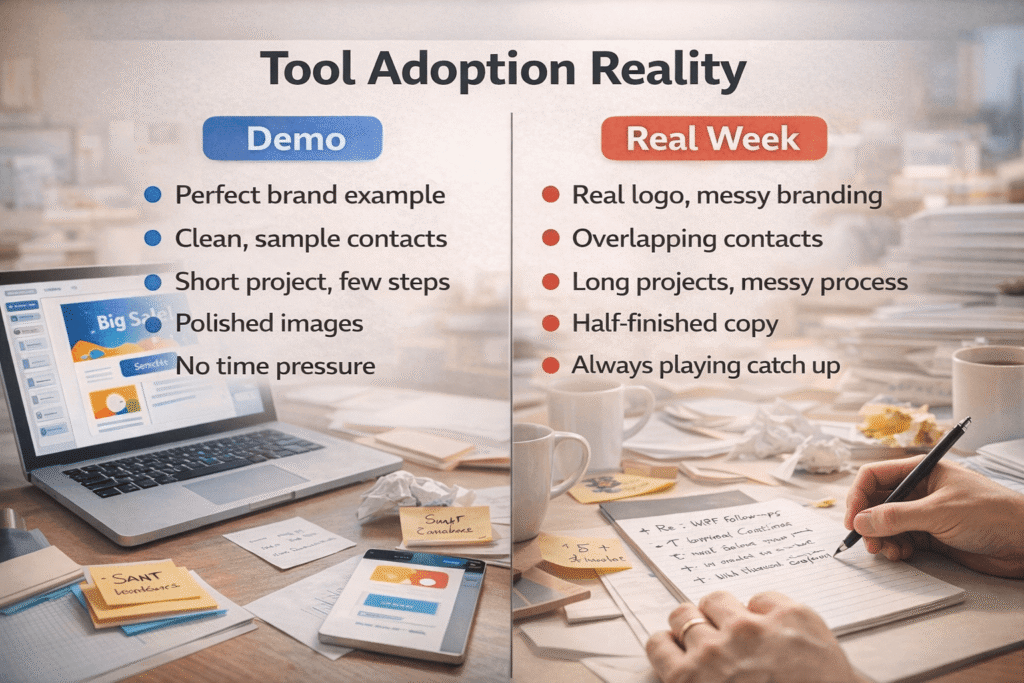
Picking based on a demo account instead of your real content and constraints
Demo accounts are designed to look good. They have clean sample data, perfect imagery, and none of your real-world problems.
Your real world is:
- a messy list,
- inconsistent branding assets,
- half-finished copy,
- multiple services,
- seasons where you’re slammed and barely have time to think.
The only honest test is building with your real constraints:
- your real logo,
- your real offer,
- your real list size,
- your real calendar.
If the tool still feels usable under those conditions, it’s probably a good fit. If it only feels good in the demo universe, it won’t survive your actual week.
Overvaluing “AI features” and undervaluing workflow clarity
A lot of platforms now push AI: subject lines, copy generation, segment suggestions, performance tips.
Some of these are genuinely helpful, especially for getting unstuck. But AI features don’t compensate for a confusing interface, brittle automation, or poor contact management.
I’d rather have a platform that makes the basics smooth and obvious than one that promises AI magic while the core workflow is frustrating.
If a tool makes it easier to send consistently, track responses, and follow up reliably, that’s already a huge advantage. AI is frosting. Workflow is the cake.
Not thinking about who on the team will actually use it
This one hits once you’re not the only person touching the tool.
A platform can be perfect for a founder who likes tinkering and terrible for a staff member who needs repeatable steps. Permissions, approvals, user roles, and shared templates start to matter.
If your team will use it, you want a tool that:
- doesn’t require tribal knowledge,
- makes it hard to accidentally break things,
- keeps campaigns organized and reusable,
- supports clean collaboration.
Otherwise the tool becomes “the one person who understands it,” which is fragile.
Chasing “all-in-one” when you really need “fits into what I already do”
There’s a difference between consolidation and convenience. A tool can offer everything and still not fit your actual operating system.
For a lot of small businesses, the best setup isn’t one mega-platform. It’s a small set of tools that connect cleanly and are easy to maintain.
The moment a platform demands you move everything into its ecosystem is the moment you should slow down and ask why. Lock-in isn’t automatically bad, but it should be a conscious trade, not an accidental one.
Letting the tool decide your strategy
This is the most subtle mistake. When you adopt a platform, you start shaping your marketing around what it makes easy.
Sometimes that’s good—it nudges you into healthier habits. Sometimes it’s limiting—it nudges you into shallow campaigns because deeper targeting or automation is hard.
Your strategy should come from your customers and your business model. The tool should support it, not replace it.
If you feel like you’re constantly simplifying your ideas to fit the platform, that’s a sign you’re either using the wrong tier or the wrong tool.
Who should take these mistakes seriously, and who can relax a bit
If your marketing is occasional and low stakes—maybe a quarterly update and the occasional promotion—you can afford a simpler tool and a little imperfection.
If your marketing is tied to real revenue, bookings, registrations, or renewals, these mistakes get expensive fast. The cost isn’t just the subscription. It’s the lost follow-up, the abandoned workflow, the team confusion, the “we meant to send that” moments.
The best marketing tools don’t feel like a new job. They feel like they quietly remove friction from what you were already trying to do.
If a tool makes you more consistent without making you more exhausted, you’re probably choosing well. If it makes you feel behind the moment you log in, that’s not a motivation problem—it’s a mismatch.